


Upper- and Lower-Secondary Students’ Motivation to Study Computer ScienceKülli Kori, Piret Luik
  Zu finden in: Informatics in Schools: Engaging Learners in Computational Thinking (Seite 69 bis 78), 2020
|
 |
 Diese Seite wurde seit 4 Jahren inhaltlich nicht mehr aktualisiert.
Unter Umständen ist sie nicht mehr aktuell.
Diese Seite wurde seit 4 Jahren inhaltlich nicht mehr aktualisiert.
Unter Umständen ist sie nicht mehr aktuell.
 Zusammenfassungen
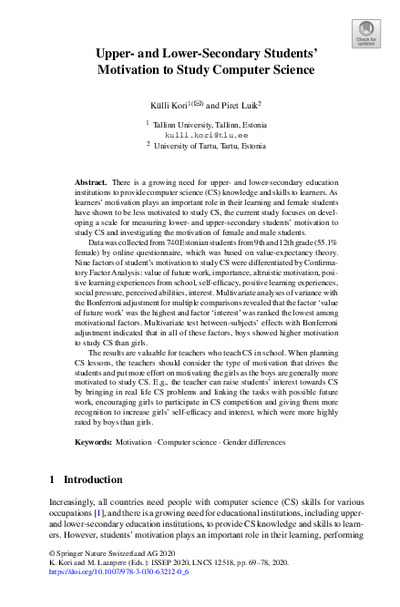
 There is a growing need for upper- and lower-secondary education institutions to provide computer science (CS) knowledge and skills to learners. As learners’ motivation plays an important role in their learning and female students have shown to be less motivated to study CS, the current study focuses on developing a scale for measuring lower- and upper-secondary students’ motivation to study CS and investigating the motivation of female and male students.
Data was collected from 740 Estonian students from 9th and 12th grade (55.1% female) by online questionnaire, which was based on value-expectancy theory. Nine factors of student’s motivation to study CS were differentiated by Confirmatory Factor Analysis: value of future work, importance, altruistic motivation, positive learning experiences from school, self-efficacy, positive learning experiences, social pressure, perceived abilities, interest. Multivariate analyses of variance with the Bonferroni adjustment for multiple comparisons revealed that the factor ‘value of future work’ was the highest and factor ‘interest’ was ranked the lowest among motivational factors. Multivariate test between-subjects’ effects with Bonferroni adjustment indicated that in all of these factors, boys showed higher motivation to study CS than girls.
The results are valuable for teachers who teach CS in school. When planning CS lessons, the teachers should consider the type of motivation that drives the students and put more effort on motivating the girls as the boys are generally more motivated to study CS. E.g., the teacher can raise students’ interest towards CS by bringing in real life CS problems and linking the tasks with possible future work, encouraging girls to participate in CS competition and giving them more recognition to increase girls’ self-efficacy and interest, which were more highly rated by boys than girls.
 Dieser wissenschaftliche Zeitschriftenartikel erwähnt ...
 Personen KB IB clear | Tiffany Barnes , Wilfried Bos , Brenda Cantwell Wilson , Amanda Chaffin , Birgit Eickelmann , Abraham E. Flanigan , Julia Gerick , Alex Godwin , Frank Goldhammer , Markeya S. Peteranetz , Eve Powell , Heather Richter , Heike Schaumburg , Renate Schulz-Zander , Knut Schwippert , Martin Senkbeil , Duane F. Shell , Leen-Kiat Soh , Heike Wendt | |||||||||||||||||||||||||||||||||||||||||||||
 Begriffe KB IB clear |
 Computercomputer
, Informatikcomputer science
, Computercomputer
, Informatikcomputer science
,  LehrerInteacher
, LehrerInteacher
,  Lernenlearning
, Lernenlearning
,  Motivationmotivation
, Selbstwirksamkeitself efficacy Motivationmotivation
, Selbstwirksamkeitself efficacy
| |||||||||||||||||||||||||||||||||||||||||||||
 Bücher |
| |||||||||||||||||||||||||||||||||||||||||||||
Texte |
|


 Dieser wissenschaftliche Zeitschriftenartikel erwähnt vermutlich nicht ...
Nicht erwähnte Begriffe | Bildung, Digitalisierung, Informatik-Didaktik, Informatik-Unterricht (Fachinformatik), Kinder, Schule, Unterricht |
Tagcloud
 Zitationsgraph
Zitationsgraph (Beta-Test mit vis.js)
 Anderswo finden

 Volltext dieses Dokuments
| Upper- and Lower-Secondary Students’ Motivation to Study Computer Science: Artikel als Volltext @ Springer (:  , 173 kByte; : , 173 kByte; :  ) ) |
 Anderswo suchen
 Beat und dieser wissenschaftliche Zeitschriftenartikel
Beat hat Dieser wissenschaftliche Zeitschriftenartikel während seiner Zeit am Institut für Medien und Schule (IMS) ins Biblionetz aufgenommen. Er hat Dieser wissenschaftliche Zeitschriftenartikel einmalig erfasst und bisher nicht mehr bearbeitet. Beat besitzt kein physisches, aber ein digitales Exemplar. Eine digitale Version ist auf dem Internet verfügbar (s.o.). Es gibt bisher nur wenige Objekte im Biblionetz, die dieses Werk zitieren.
 Biblionetz-History