


Laptops and LiteracyA Multi-Site Case Study
Erstpublikation in: Pedagogies: An International Journal, 3: 52–67, 2008
Publikationsdatum:
 |
 |
 Diese Seite wurde seit 3 Jahren inhaltlich nicht mehr aktualisiert.
Unter Umständen ist sie nicht mehr aktuell.
Diese Seite wurde seit 3 Jahren inhaltlich nicht mehr aktualisiert.
Unter Umständen ist sie nicht mehr aktuell.
 Zusammenfassungen
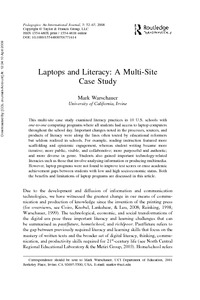
 This article presents findings from a 2-year laptop and literacy study
conducted in Southern California from 2003 to 2005. The study was designed to
examine the relationship of laptop use to student literacy practices. A complete
report on the findings can be found in Warschauer (2006). This article is a
summary of the study’s major findings.This multi-site case study examined literacy practices in 10 U.S. schools with
one-to-one computing programs where all students had access to laptop computers
throughout the school day. Important changes noted in the processes, sources, and
products of literacy were along the lines often touted by educational reformers
but seldom realized in schools. For example, reading instruction featured more
scaffolding and epistemic engagement, whereas student writing became more
iterative; more public, visible, and collaborative; more purposeful and authentic;
and more diverse in genre. Students also gained important technology-related
literacies such as those that involve analysing information or producing multimedia.
However, laptop programs were not found to improve test scores or erase academic
achievement gaps between students with low and high socioeconomic status. Both
the benefits and limitations of laptop programs are discussed in this article.
This article presents findings from a 2-year laptop and literacy study
conducted in Southern California from 2003 to 2005. The study was designed to
examine the relationship of laptop use to student literacy practices. A complete
report on the findings can be found in Warschauer (2006). This article is a
summary of the study’s major findings.This multi-site case study examined literacy practices in 10 U.S. schools with
one-to-one computing programs where all students had access to laptop computers
throughout the school day. Important changes noted in the processes, sources, and
products of literacy were along the lines often touted by educational reformers
but seldom realized in schools. For example, reading instruction featured more
scaffolding and epistemic engagement, whereas student writing became more
iterative; more public, visible, and collaborative; more purposeful and authentic;
and more diverse in genre. Students also gained important technology-related
literacies such as those that involve analysing information or producing multimedia.
However, laptop programs were not found to improve test scores or erase academic
achievement gaps between students with low and high socioeconomic status. Both
the benefits and limitations of laptop programs are discussed in this article. Bemerkungen
 Leider ist die ursprünglich im Biblionetz erfasste URL eines Volltextes seit mehr als sechs Monaten nicht mehr gültig (Fehlermeldung 404) und wurde deshalb gelöscht. Es ist mir nicht bekannt, ob das Dokument unter einer anderen Adresse noch frei auf dem Internet verfügbar ist.
 Dieser Text erwähnt ...


 Dieser Text erwähnt vermutlich nicht ...
Nicht erwähnte Begriffe | Notebook, Notebooks an Schulen |
 Tagcloud
 Zitationsgraph
Zitationsgraph (Beta-Test mit vis.js)
 Zeitleiste
 5 Erwähnungen
- Learning to Write in the Laptop Classroom (Mark Warschauer) (2009)

- Bedingungen innovativen Handelns in Schulen - Funktion und Interaktion von Innovationsbereitschaft, Innovationsklima und Akteursnetzwerken am Beispiel der IKT-Integration an Schulen (Doreen Prasse) (2012)

- Digital Writing and Diversity - The Effects of School Laptop Programs on Literacy Processes and Outcomes (Binbin Zheng, Mark Warschauer, George Farkas) (2013)
- Cyberkrank! - Wie das digitalisierte Leben unsere Gesundheit ruiniert (Manfred Spitzer) (2015)
- Second Handbook of Information Technology in Primary and Secondary Education (Joke Voogt, Gerald Knezek, Rhonda Christensen, Kwok-Wing Lai) (2018)
 Volltext dieses Dokuments
| Laptops and Literacy: Artikel als Volltext (:  , 83 kByte) , 83 kByte) |
 Anderswo suchen
 Beat und dieser Text
Beat hat Dieser Text während seiner Zeit am Institut für Medien und Schule (IMS) ins Biblionetz aufgenommen. Beat besitzt kein physisches, aber ein digitales Exemplar. (das er aber aus Urheberrechtsgründen nicht einfach weitergeben darf). Es gibt bisher nur wenige Objekte im Biblionetz, die dieses Werk zitieren.
 Biblionetz-History