


100 Things Every Designer Needs to Know About People |
|
 Zusammenfassungen
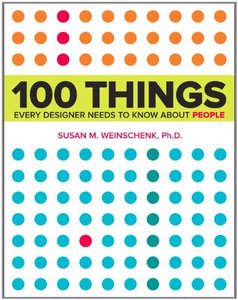
 If you want to design intuitive and engaging web sites, apps, print materials or products, then you need to know the psychology that underlies people's behavior. 100 Things Every Designer Needs to Know About People explores both the foundational and the latest research in the psychology of the conscious mind and applies it to design. What grabs and holds attention on a page or screen? What is more important, peripheral vision or central vision? How much information is too much at one time? How do you motivate people to continue on to the next step? What line length should you use if you want people to read text on or offline? What about color? Imagery? Does font type really matter? These are just a few of the questions that the book answers.
 This book is not just a set of guidelines, but a deep dive into what makes people tick. Dr. Weinschenk shares the psychology research and shows lots of examples so that you can design intuitive and engaging print, web, applications and products that match the way people think, work, and play.
If you want to design intuitive and engaging web sites, apps, print materials or products, then you need to know the psychology that underlies people's behavior. 100 Things Every Designer Needs to Know About People explores both the foundational and the latest research in the psychology of the conscious mind and applies it to design. What grabs and holds attention on a page or screen? What is more important, peripheral vision or central vision? How much information is too much at one time? How do you motivate people to continue on to the next step? What line length should you use if you want people to read text on or offline? What about color? Imagery? Does font type really matter? These are just a few of the questions that the book answers. This book is not just a set of guidelines, but a deep dive into what makes people tick. Dr. Weinschenk shares the psychology research and shows lots of examples so that you can design intuitive and engaging print, web, applications and products that match the way people think, work, and play.
 Dieses Buch erwähnt ...
 Affordance
 Algorithmus
 Aufmerksamkeit / Fokus
 Classification
 delay of gratification
 Denken
 Design
 Dopamin
 E-Mail
 Emotionen
 Evolution
 facebook
 Gehirn
 Gesichtserkennung
 Google
 GUI (Graphical User Interface)
 Hyperlink
 instant gratification
 Kreativität
 Lesen am Bildschirm
 Mobiltelefon
 Motivation
 Motivation, extrinsische
 Motivation, intrinsische
 Procrastination
 Psychologie
 Random gratification
 Twitter
 Wahrnehmung
 Zeit
Zeit


 Dieses Buch erwähnt vermutlich nicht ...
Nicht erwähnte Begriffe | Daten, Hormon, Internet, Lesen auf Papier |
 Tagcloud
 Zitationsgraph
Zitationsgraph (Beta-Test mit vis.js)
 Volltext dieses Dokuments
 | 100 Things Every Designer Needs to Know About People: Gesamtes Buch als Volltext (:  , 6367 kByte) , 6367 kByte) |
 Bibliographisches
| Titel | Format | Bez. | Aufl. | Jahr | ISBN | ||||||
| 100 Things Every Designer Needs to Know About People | e | - | - | 1 | 2011 | 0321767535 |  |
 |
 |
 |
 Beat und dieses Buch
Beat hat dieses Buch während seiner Zeit am Institut für Medien und Schule (IMS) ins Biblionetz aufgenommen. Beat besitzt kein physisches, aber ein digitales Exemplar. (das er aber aus Urheberrechtsgründen nicht einfach weitergeben darf). Es gibt bisher nur wenige Objekte im Biblionetz, die dieses Werk zitieren.
 Biblionetz-History