


The Importance of Information Technology Attitudes and Competencies in Primary and Secondary Education  Zu finden in: International Handbook of Information Technology in Primary and Secondary Education (Seite 321 bis 331), 2009
|
 |
 Diese Seite wurde seit 2 Jahren inhaltlich nicht mehr aktualisiert.
Unter Umständen ist sie nicht mehr aktuell.
Diese Seite wurde seit 2 Jahren inhaltlich nicht mehr aktualisiert.
Unter Umständen ist sie nicht mehr aktuell.
 Zusammenfassungen
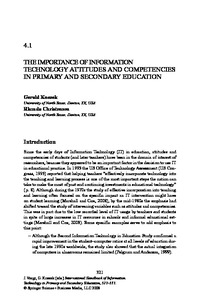
 Since the early days of Information Technology (IT) in education, attitudes and competencies of students (and later teachers) have been in the domain of interest of researchers, because they appeared to be an important factor in the decision to use IT in educational practice. In 1995 the US Office of Technology Assessment (US Congress, 1995) reported that helping teachers 'effectively incorporate technology into the teaching and learning process is one of the most important steps the nation can take to make the most of past and continuing investments in educational technology†(p. 8). Although during the 1970s the study of effective incorporation into teaching and learning often focused on the specific impact an IT intervention might have on student learning (Marshall and Cox, 2008), by the mid-1980s the emphasis had shifted toward the study of intervening variables such as attitudes and competencies. This was in part due to the low recorded level of IT usage by teachers and students in spite of large increases in IT resources in schools and informal educational settings (Marshall and Cox, 2008). Some specific examples serve to add emphasis to this point:
  Dieses Kapitel erwähnt ...
 Computer
 Early Adopter
 early majority
 innovator
 laggard
 late majority
 Lernen


 Dieses Kapitel erwähnt vermutlich nicht ...
Nicht erwähnte Begriffe | Schule |
 Tagcloud
 Zitationsgraph
Zitationsgraph (Beta-Test mit vis.js)
 Zeitleiste
 7 Erwähnungen
- Why do some teachers teach media literacy while others do not? - Exploring predictors along the “will, skill, tool, pedagogy” model (Maria-Luisa Schmitz, Tessa Consoli, Chiara Antonietti, Alberto Cattaneo, Philipp Gonon, Dominik Petko)
- Grundschule in der digitalen Gesellschaft (Birgit Eickelmann, Ramona Lorenz, Mario Vennemann, Julia Gerick, Wilfried Bos) (2014)
- Individuell fördern mit digitalen Medien - Chancen, Risiken, Erfolgsfaktoren (Bertelsmann Stiftung) (2015)
- Chancen und Risiken digitaler Medien in der Schule - Medienpädagogische und -didaktische Perspektiven (Heike Schaumburg) (2015)
- Chancen und Risiken digitaler Medien in der Schule - Medienpädagogische und -didaktische Perspektiven (Heike Schaumburg) (2015)
- Second Handbook of Information Technology in Primary and Secondary Education (Joke Voogt, Gerald Knezek, Rhonda Christensen, Kwok-Wing Lai) (2018)
- 16. The Evolving Role of Attitudes and Competencies in Information and Communication Technology in Education (Gerald Knezek, Rhonda Christensen)
- 19. The Influence of Information and Communication Technology Use on Students´ Information Literacy (Akira Sakamoto)
- 27. Information and Communication Technology Dispositional Factors and Relationship to Information and Communication Technology Practices (Anne T. Ottenbreit-Leftwich, Theodore J. Kopcha, Peggy A. Ertmer)
- 16. The Evolving Role of Attitudes and Competencies in Information and Communication Technology in Education (Gerald Knezek, Rhonda Christensen)
- ICT-Professionalisierung und ICT-Beliefs - Professionalisierung angehender Lehrpersonen in der digitalen Transformation und ihre berufsbezogenen Überzeugungen über digitale Informations- und Kommunikationstechnologien (ICT) (Robin Schmidt) (2020)
 Anderswo finden

 Volltext dieses Dokuments
| The Importance of Information Technology Attitudes and Competencies in Primary and Secondary Education: Artikel als Volltext bei Springerlink (:  , 136 kByte; : , 136 kByte; :  2020-11-28) 2020-11-28) |
 Anderswo suchen
 Beat und dieses Kapitel
Beat hat Dieses Kapitel während seiner Zeit am Institut für Medien und Schule (IMS) ins Biblionetz aufgenommen. Beat besitzt kein physisches, aber ein digitales Exemplar. Eine digitale Version ist auf dem Internet verfügbar (s.o.). Es gibt bisher nur wenige Objekte im Biblionetz, die dieses Werk zitieren.
 Biblionetz-History