


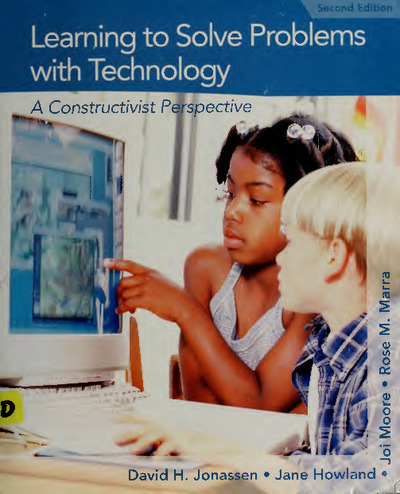
Learning to Solve Problems with Technology (2nd ed.)A Constructivist Perspective
|
|

 Zusammenfassungen
 For Computers in Education courses, and courses in Instructional Media and Technology, this text stresses that technology video, hypermedia, the Internet, etc. is an excellent tool to learn with. The emphasis is on learning to solve problems.
 "Learning to Solve Problems with Technology: A Constructivist Perspective" is about how educators can use technologies to support constructive learning. In the past, technology has largely been used in education to learn/rom. Technology programs were developed with the belief that they could convey Information (and hopefully understanding) more effectively than teachers. But constructivists believe that you cannot convey understanding - that can only be constructed by learners. This book argues that technologies are more effectively used as tools to construct knowledge *with*. The point is that technology is a tool to think and learn *with*.
 im Buch Learning to Solve Problems with Technology (2nd ed.) (2003)
  Kapitel
- 1. What is Meaningful Learning? (Jane Howland, David H. Jonassen, Rose M. Marra, Joi Moore )
- 2. Problem Solving Is Meaningful Learning (Jane Howland, David H. Jonassen, Rose M. Marra, Joi Moore )
- 3. Learning From the Internet - Information to Knowledge Through Inquiry (Jane Howland, David H. Jonassen, Rose M. Marra, Joi Moore )
- 4. Building Technology-Supported Learning Communitites on the Internet (Jane Howland, David H. Jonassen, Rose M. Marra, Joi Moore )
- 5. Learning by Visualizing With Technology - Recording Realites With Video (Jane Howland, David H. Jonassen, Rose M. Marra, Joi Moore )
- 6. Learning by Constructing Realities With Hypermedia (Jane Howland, David H. Jonassen, Rose M. Marra, Joi Moore )
- 7. Learning by Exploring Microworlds and Virtual Realities (Jane Howland, David H. Jonassen, Rose M. Marra, Joi Moore )
- 8. Learning in Problem-Based Learning Environments (Jane Howland, David H. Jonassen, Rose M. Marra, Joi Moore )
- 9. Assessing Constructive Learning and Problem Solving With Technology (Jane Howland, David H. Jonassen, Rose M. Marra, Joi Moore )
 Dieses Buch erwähnt ...
 Algorithmus
 Aufmerksamkeit / Fokus
 CD (Compact Disc)
 Chat
Chat Datenträger
 distance learning / Fernunterricht
 E-Mail
 E-Mail Attachments
 Gruppenarbeit
 Intelligenz
 Internet
 Kommunikation
 Kreativität
 Lernen
 LOGO (Programmiersprache)
 Media Lab (MIT)
 MIT
MIT Multimedia
 Problem
 Schule
 Struktur
 Suchmaschine
 Virtual Reality
 WLAN / Wireless LAN
 WWW (World Wide Web)


 Dieses Buch erwähnt vermutlich nicht ...
Nicht erwähnte Begriffe | Bildung, Computer, Digitalisierung, Hypertext, Kinder, Künstliche Intelligenz (KI / AI), LehrerIn, Multicodierung, Newsgroups, Primarschule (1-6) / Grundschule (1-4), Schule im Netz (PPP-SiN) (Schweiz), Schulen ans Netz (Deutschland), Schweiz, Synchrone computervermittelte Kommunikation, Synchrone Kommunikation, Unterricht, Wireless Computing an Schulen |
 Tagcloud
 Zitationsgraph
Zitationsgraph (Beta-Test mit vis.js)
 Zeitleiste
 5 Erwähnungen
- Does ICT contribute to powerful learning environments in primary education? (Ed Smeets) (2005)


- Digital Didactical Designs - Teaching and Learning in CrossActionSpaces (Isa Jahnke) (2015)
- 1. The Internet in Our Pockets and Handbags; ICT Is More Than Just a Tool
- 4. Learning as Reflective Crossaction - The Example of Learning Expeditions
- 5. Teaching Creates Conditions for Learning as Reflective Cross-Action - Digital Didactical Design
- Tablets in Schule und Unterricht - Forschungsmethoden und -perspektiven zum Einsatz digitaler Medien (Jasmin Bastian, Stefan Aufenanger) (2017)
- 3. Tablets im Schulunterricht in Skandinavien - Der Ansatz des Digitalen Didaktischen Design (DDD) für empirische Studien: Designs-in-Practice (Isa Jahnke)
- 3. Tablets im Schulunterricht in Skandinavien - Der Ansatz des Digitalen Didaktischen Design (DDD) für empirische Studien: Designs-in-Practice (Isa Jahnke)
 Co-zitierte Bücher


 Volltext dieses Dokuments
| Learning to Solve Problems with Technology (2nd ed.): Gesamtes Buch als Volltext (:  , 15119 kByte) , 15119 kByte) |
 Standorte
 Bibliographisches
| Titel | Format | Bez. | Aufl. | Jahr | ISBN | ||||||
| Learning to Solve Problems with Technology | E | Paperback | - | 2 | 2003 | 0130484042 |  |
 |
 |
 |
 Beat und dieses Buch
Beat war Co-Leiter des ICT-Kompetenzzentrums TOP während er dieses Buch ins Biblionetz aufgenommen hat. Die bisher letzte Bearbeitung erfolgte während seiner Zeit am Institut für Medien und Schule. Beat besitzt ein physisches und ein digitales Exemplar. (das er aber aus Urheberrechtsgründen nicht einfach weitergeben darf). Aufgrund der vielen Verknüpfungen im Biblionetz scheint er sich intensiver damit befasst zu haben. Es gibt bisher nur wenige Objekte im Biblionetz, die dieses Werk zitieren.
 Biblionetz-History