


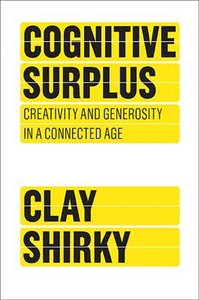
Cognitive SurplusCreativity and Generosity in a Connected Age
|
|
 Zusammenfassungen
 This book is about the novel resource that has appeared as the world's cumulative free time is addressed in aggregate. The two most important transitions allowing us access to this resource have already happened—the buildup of well over a trillion hours of free time each year on the part of the world's educated population, and the invention and spread of public media that enable ordinary citizens, previously locked out, to pool that free time in pursuit of activities they like or care about. Those two facts are common to every story in this book, from inspirational work like Ushahidi to mere self-amusement like lolcats. Understanding those two changes, as different as they are from the media landscape of the twentieth Century, is just the beginning of understanding what is Happening today, and what is possible tomorrow.For decades, technology encouraged people to squander their time and intellect as passive consumers. Today, tech has finally caught up with human potential. In Cognitive Surplus, Internet guru Clay Shirky forecasts the thrilling changes we will all enjoy as new digital technology puts our untapped resources of talent and goodwill to use at last. Since we Americans were suburbanized and educated by the postwar boom, we've had a surfeit of intellect, energy, and time-what Shirky calls a cognitive surplus. But this abundance had little impact on the common good because television consumed the lion's share of it-and we consume TV passively, in isolation from one another. Now, for the first time, people are embracing new media that allow us to pool our efforts at vanishingly low cost. The results of this aggregated effort range from mind expanding-reference tools like Wikipedia-to lifesaving-such as Ushahidi.com, which has allowed Kenyans to sidestep government censorship and report on acts of violence in real time. Shirky argues persuasively that this cognitive surplus-rather than being some strange new departure from normal behavior-actually returns our society to forms of collaboration that were natural to us up through the early twentieth century. He also charts the vast effects that our cognitive surplus-aided by new technologies-will have on twenty-first-century society, and how we can best exploit those effects. Shirky envisions an era of lower creative quality on average but greater innovation, an increase in transparency in all areas of society, and a dramatic rise in productivity that will transform our civilization. The potential impact of cognitive surplus is enormous. As Shirky points out, Wikipedia was built out of roughly 1 percent of the man-hours that Americans spend watching TV every year. Wikipedia and other current products of cognitive surplus are only the iceberg's tip. Shirky shows how society and our daily lives will be improved dramatically as we learn to exploit our goodwill and free time like never before.
 Kapitel
 Dieses Buch erwähnt ...
 Personen KB IB clear | Christine Benesch , Bruno S. Frey , Clay Shirky , A. Stutzer | ||||||||||||||||||
 Aussagen KB IB clear |
Fernsehen macht unglücklich
Fernsehen nimmt einen grossen Teil der verfügbaren Freizeit ein Fernsehkonsum fördert Angst Fernsehkonsum führt dazu, dass wir weniger zwischenmenschliche Kontakte haben | ||||||||||||||||||
 Begriffe KB IB clear |
 Fernsehentelevision
, Fernsehentelevision
,  Freizeit
, Geldwäscherei
, Freizeit
, Geldwäscherei
,  Gesellschaftsociety
, Gesellschaftsociety
,  Industriegesellschaftindustrial age
, Industrielle Revolutionindustrial revolution
, Industriegesellschaftindustrial age
, Industrielle Revolutionindustrial revolution
,  Informationsgesellschaftinformation society
, Medienmedia
, Informationsgesellschaftinformation society
, Medienmedia
,  Mensch
, Mensch
,  Wikipedia
, World of Warcraft Wikipedia
, World of Warcraft
| ||||||||||||||||||
 Bücher |
| ||||||||||||||||||
Texte |
|

Tagcloud
 Zitationsgraph
Zitationsgraph (Beta-Test mit vis.js)
 Zeitleiste
 23 Erwähnungen
- Theories of the Information Society - 4th Edition (Frank Webster) (1995)

- Die Internet-Falle - Google+, Facebook, Staatstrojaner - Was Sie für Ihren sicheren Umgang mit dem Netz wissen müssen (Thomas R. Köhler) (2010)

- 4. Hinter den Kulissen des Social Web
- A New Culture of Learning - Cultivating the Imagination for a World of Constant Change (Douglas Thomas, J. S. Brown) (2011)
- The Semantic Sphere - Computation, Cognition and Information Economy (Pierre Lévy) (2011)

- The Digital Scholar - How Technology is Transforming Academic Practice (Martin Weller) (2011)
- Public Parts - How Sharing in the Digital Age Improves the Way We Work and Live (Jeff Jarvis) (2011)
- Robots Will Steal Your Job, But That's OK - how to survive the economic collapse and be happy (Frederico Pistono) (2012)
- The Half-life of Facts - Why Everything We Know Has an Expiration Date (Samuel Arbesman) (2012)
- Programming the Global Brain (Abraham Bernstein, Mark Klein, Thomas W. Malone) (2012)
- Internet - Segen oder Fluch (Kathrin Passig, Sascha Lobo) (2012)
- 1. Null oder Eins? - Ja. - Über Verständigungsschwierigkeiten
- 1. Null oder Eins? - Ja. - Über Verständigungsschwierigkeiten
- Die stille Revolution - Wie Algorithmen Wissen, Arbeit, Öffentlichkeit und Politik verändern, ohne dabei viel Lärm zu machen (Mercedes Bunz) (2012)
- To Save Everything, Click Here - The Folly of Technological Solutionism (Evgeny Morozov) (2013)
- Digital Disconnect - How Capitalism is Turning the Internet Against Democracy (Robert McChesney) (2013)
- 1. What Is the Elephant in the Digital Room?
- The participatory web in the context of academic research - Landscapes of change and conflicts (Cristina Costa) (2013)
- Present Shock - When Everything Happens Now (Douglas Rushkoff) (2013)
- 2. Digiphrenie
- Digital Exposure - Postmodern Postcapitalism (Raphael Sassower) (2013)
- it's complicated - the social lives of networked teens (danah boyd) (2014)
- The War on Learning (Elizabeth Losh) (2014)
- Connected Code - Why Children Need to Learn Programming (Yasmin B. Kafai, Quinn Burke) (2014)
- Der Bürger im Staat 4/2014 - Politik und Internet (2014)
- Internet und Lernen - Auswirkungen des Social und Mobile Web auf Lernprozesse und Lerninfrastrukturen (Joachim Griesbaum) (2014)
- Internet und Lernen - Auswirkungen des Social und Mobile Web auf Lernprozesse und Lerninfrastrukturen (Joachim Griesbaum) (2014)
- Die Bildung und das Netz - Wie leben und lernen wir im digitalen Klimawandel? (Martin Lindner) (2017)
- The Magic of Code - How Digital Language Created and Connects Our World―and Shapes Our Future (Samuel Arbesman) (2025)
Co-zitierte Bücher


Bowling alone
(Robert Putnam) (2000) Little Science, Big Science
(Derek de Solla Price) (1963)
How Big Media Uses Technology and the Law to Lock Down Culture and Control Creativity
(Lawrence Lessig) (2004) 

Warum Gruppen klüger sind als Einzelne und wie wir das kollektive Wissen für unser wirtschaftliches, soziales und politisches Handeln nutzen können
The Wisdom of Crowds
(James Surowiecki) (2004) 
No Sense of Place
The Impact of Electronic Media on Social Behaviour
(Joshua Meyrowitz) (1985)


Elemente einer kritischen Internetkultur
Zero Comments
Blogging and Critical Internet Culture
(Geert Lovink) (2007) How blogs, MySpace, YouTube, and the rest of today's user-generated media are destroying our economy, our culture, and our values
(Andrew Keen) (2008)


Eine kurze Geschichte der Innovation
Where Good Ideas Come From
The Natural History of Innovation
(Steven Johnson) (2010) 
Das Wissen neu denken, denn Fakten sind keine Fakten mehr, die Experten sitzen überall und die schlaueste Person im Raum ist der Raum
Too Big to Know
Rethinking Knowledge Now That the Facts Aren't the Facts, Experts Are Everywhere, and the Smartest Person in the Room
(David Weinberger) (2012) 
How Technology Can Make Government Better, Democracy Stronger, and Citizens More Powerful
(Beth Simone Noveck) 


Hanging Out, Messing Around, and Geeking Out
kids living and learning with new media
(Mizuko Ito, Sonja Baumer, Matteo Bittanti, danah boyd, Rachel Cody, Becky Herr-Stephenson, Heather Horst, Patricia G. Lange, Dilan Mahendran, Katynka Z. Martínez, C.J. Pascoe, Dan Perkel, Laura Robinson, Christo Sims, Lisa Tripp) (2010) 


 Volltext dieses Dokuments
| Cognitive Surplus: Gesamtes Buch als Volltext (:  , 895 kByte) , 895 kByte) |
 Standorte
 Bibliographisches
| Titel | Format | Bez. | Aufl. | Jahr | ISBN | ||||||
| Cognitive Surplus | D | - | - | 0 | 2010 | 1594202532 |  |
 |
 |
 Beat und dieses Buch
Beat hat dieses Buch während seiner Zeit am Institut für Medien und Schule (IMS) ins Biblionetz aufgenommen. Beat besitzt ein physisches und ein digitales Exemplar. (das er aber aus Urheberrechtsgründen nicht einfach weitergeben darf).
 Biblionetz-History