


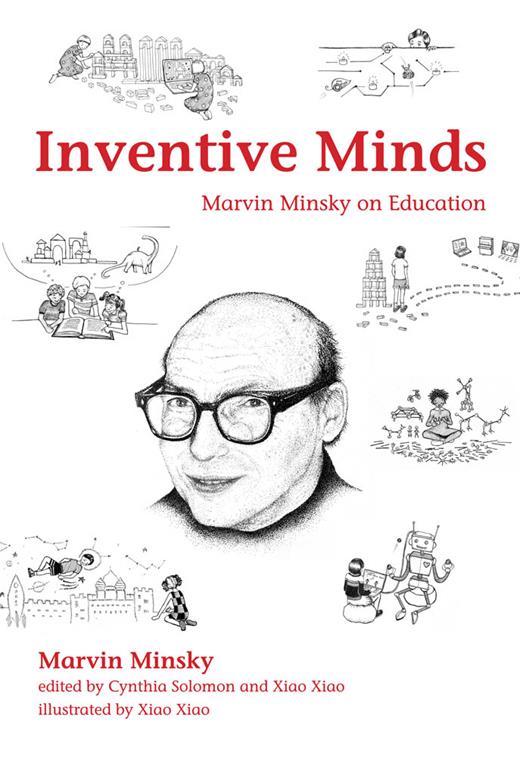
Inventive MindsMarvin Minsky on Education
|
|
 Diese Seite wurde seit 2 Jahren inhaltlich nicht mehr aktualisiert.
Unter Umständen ist sie nicht mehr aktuell.
Diese Seite wurde seit 2 Jahren inhaltlich nicht mehr aktualisiert.
Unter Umständen ist sie nicht mehr aktuell.
 Zusammenfassungen
 Summary
Six essays by artificial intelligence pioneer Marvin Minsky on how education can foster inventiveness, paired with commentary by Minsky's former colleagues and students.
Summary
Six essays by artificial intelligence pioneer Marvin Minsky on how education can foster inventiveness, paired with commentary by Minsky's former colleagues and students. Marvin’s insights about the mind are relevant not only for creating intelligent machines, but also for providing new per-spectives on children’s learning and thinking, as well as on the role of computers, both in education and in schools. These are the topics explored by the essays in this book.Marvin Minsky was a pioneering researcher in artificial intelligence whose work led to both theoretical and practical advances. His work was motivated not only by technological advancement but also by the desire to understand the workings of our own minds. Minsky's insights about the mind provide fresh perspectives on education and how children learn. This book collects for the first time six essays by Minsky on children, learning, and the potential of computers in school to enrich children's development. In these essays Minsky discusses the shortcomings of conventional education (particularly in mathematics) and considers alternative approaches; reflects on the role of mentors; describes higher-level strategies for thinking across domains; and suggests projects for children to pursue. Each essay is paired with commentary by one of Minsky's former colleagues or students, which identifies Minsky's key ideas and connects his writings to current research. Minsky once observed that in traditional teaching, “instead of promoting inventiveness, we focus on preventing mistakes.” These essays offer Minsky's unique insights into how education can foster inventiveness.
 Bemerkungen zu diesem Buch
n these six essays, Marvin shares his wisdom about children, learning, school, and computation. He emphasizes computers not only as tools for learning typical subject areas like math but also as offering opportunities for children to learn “good ways to think about thinking” itself. One way of doing this, Marvin suggests, is “to get children to think of themselves as though they were programmed computers” (essay 4). For instance, in my Logo classes children were asked to “play turtle” or to become researchers collecting both computer and human bugs, to talk about necessary debugging steps, and at times to recognize that some bugs can be features.Another one of Marvin’s ever-sharp observations is about teaching: “instead of promoting inventiveness, we focus on pre-venting mistakes.” In teaching children arithmetic, he suspected that “this negative emphasis leads many children not only to dislike Arithmetic, but also later to become averse to everything else that smells of technology (essay 2).
Unsurprisingly, these essays are relevant to today’s discussions about school, computers, and learning. I assume most readers have thought about the issues raised here; Marvin adds a refresh-ing perspective. We leave it to you to bring in your knowledge of other writers and researchers offering similar, or contrary, points of view. Enjoy Marvin’s wisdom.
 Kapitel
 Dieses Buch erwähnt ...
 Personen KB IB clear | Sigmund Freud , Alan Kay , Stanley Kubrick , John McCarthy , Warren McCulloch , Marvin Minsky , Nicholas Negroponte , Seymour Papert , Jean Piaget , Brian Silverman , Gary Stager | ||||||||||||||||||||||||||||||||||||
 Begriffe KB IB clear |
Bildungeducation (Bildung)
,  Computercomputer
, Computercomputer
,  Denkenthinking
, Denkenthinking
,  Kinderchildren
, Kinderchildren
,  Künstliche Intelligenz (KI / AI)artificial intelligence
, Künstliche Intelligenz (KI / AI)artificial intelligence
,  Lernenlearning
, LISP
, Lernenlearning
, LISP
,  LOGO (Programmiersprache)LOGO (programming language)
, LOGO (Programmiersprache)LOGO (programming language)
,  Mathematikmathematics
, Mathematikmathematics
,  Media Lab (MIT)Media Lab (MIT)
, Media Lab (MIT)Media Lab (MIT)
,  OLPCOne Laptop per Child Project
, OLPCOne Laptop per Child Project
,  Programmierenprogramming
, Programmierenprogramming
,  Schuleschool
, Smalltalk
, Schuleschool
, Smalltalk
,  turtle graphics turtle graphics
| ||||||||||||||||||||||||||||||||||||
 Bücher |
|


 Dieses Buch erwähnt vermutlich nicht ...
Nicht erwähnte Begriffe | Digitalisierung, Eltern, LehrerIn, Schweiz, Unterricht |
Tagcloud
 Zitationsgraph
Zitationsgraph (Beta-Test mit vis.js)
 Volltext dieses Dokuments
 | Preface: Artikel als Volltext (:  , 5105 kByte) , 5105 kByte) |
|  Inventive Minds: Gesamtes Buch als Volltext (: , 41068 kByte; : Inventive Minds: Gesamtes Buch als Volltext (: , 41068 kByte; :  2021-03-21) 2021-03-21) |
 Anderswo suchen
 Beat und dieses Buch
Beat hat dieses Buch während seiner Zeit am Institut für Medien und Schule (IMS) ins Biblionetz aufgenommen. Beat besitzt kein physisches, aber ein digitales Exemplar. Eine digitale Version ist auf dem Internet verfügbar (s.o.). Es gibt bisher nur wenige Objekte im Biblionetz, die dieses Werk zitieren.
 Biblionetz-History