


The Society of Mind |
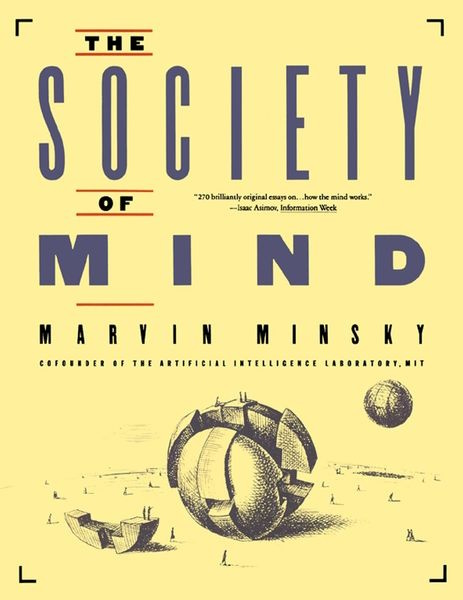
|
 Diese Seite wurde seit 1 Jahr inhaltlich nicht mehr aktualisiert.
Unter Umständen ist sie nicht mehr aktuell.
Diese Seite wurde seit 1 Jahr inhaltlich nicht mehr aktualisiert.
Unter Umständen ist sie nicht mehr aktuell.
 Empfehlungen
 In 270 very readable one-page essays, Minsky presents a society of ideas about the society of mind. It is true Zen. Every page is a mob of astounding and mind-changing ideas. And at every point in thinking about complex systems I would come back to Minsky. This is the book that eventually led me to write this book.
 Zusammenfassungen
 An authority on artificial intelligence introduces a theory that explores the workings of the human mind and the mysteries of thought.Mit diesem Buch will ich zu erklären versuchen, wie Geist funktioniert. Wie kann Intelligenz aus Nicht-Intelligenz entstehen? Um diese Frage zu beantworten, werde ich zeigen, wie man Geist aus kleinen Teilen zusammensetzen kann, die jedes für sich ohne Geist sind.
 Ich nenne diesen Entwurf »Mentopolis«, von lateinisch mens und griechisch polis, wörtlich »Die Geistesgesellschaft«, da ihm zufolge jeder Geist aus vielen kleineren Prozessen entstanden ist. Diese Prozesse nenne ich Agenten. Jeder mentale Agent ist für sich allein genommen nur zu einfachen Tätigkeiten fähig, die weder Geist noch Denken erfordern. Wenn wir diese Agenten jedoch auf eine ganz bestimmte Weise zu Gesellschaften zusammenfassen, ist das Ergebnis echte Intelligenz.
Dieses Buch macht geltend, daß jedes Gehirn, jede Maschine oder jedes andere Ding, das Geist besitzt, aus kleineren Dingen komponiert sein muß, die überhaupt nicht denken können. Die Struktur dieses Buches selbst spiegelt diese Ansicht wider: jede Seite erforscht eine Theorie oder Idee, die verwendet, was andere Seiten tun. Einige Leser mögen eine gebräuchlichere Form der Darstellung bevorzugen. Ich habe mich mehrmals darin versucht, aber es gelang mir nie; wie ich die Dinge auch anzuordnen versuchte, immer blieben viele Gedanken übrig, die sich nicht einfügen ließen. Der Geist ist zu komplex, um sich einer Erzählform anzupassen, die hier beginnt und dort endet; ein menschlicher Intellekt hängt von den Verbindungen in einem sehr dicht verknüpften Spinnennetz ab, das einfach seine Aufgabe nicht erfüllen würde, wenn alles hübsch geradlinig angeordnet wäre. Bemerkungen zu diesem Buch
 In summary, there appears to be no simple definition of intelligence that is
satisfactory to most observers, and most would-be definers of intelligence end up
with long checklists of its attributes. Minsky's Society of Mind can be viewed as a
book-length attempt at such a definition.
In summary, there appears to be no simple definition of intelligence that is
satisfactory to most observers, and most would-be definers of intelligence end up
with long checklists of its attributes. Minsky's Society of Mind can be viewed as a
book-length attempt at such a definition. Dieses Buch erwähnt ...
 Computer
 Denken
 Gehirn
 gerrymandering
 Hierarchie
 Identität
 Intelligenz
 Kommunikation
 Künstliche Intelligenz (KI / AI)
 Leben
Leben Lernen
 machine learning
 Maschine
 Nervensystem
 Perceptron
 Seele
Seele Sprache
 Wahrnehmung
 Wissen
 Dieses Buch erwähnt vermutlich nicht ...
Nicht erwähnte Begriffe | Neuron, Schule, Ultra-Kurzzeitgedächtnis, Wissensmanagement |
 Tagcloud
 2 Einträge in Beats Blog
 Zitationsgraph
Zitationsgraph (Beta-Test mit vis.js)
 Zeitleiste
 47 Erwähnungen
- Playground - an object-oriented simulation system with agent rules for children of all ages (Jay Fenton, Kent Beck)


- An AI Learning Hierarchy (Peter J. Denning, Ted G. Lewis)
- The Society of Text - hypertext, hypermedia, and the social construction of information (Edward Barrett) (1989)

- Introduction - Thought and Language in a Virtual Environment
- Epistemological Pluralism: Styles and Voices Within the Computer Culture (Sherry Turkle, Seymour Papert) (1990)
- Constructionism (Idit Harel, Seymour Papert) (1990)
- The Age of Intelligent Machines (Ray Kurzweil) (1990)
- Intelligence without representation (Rodney Brooks) (1991)
- Intelligence without reason (Rodney Brooks) (1991)
- LOG IN 1/1992 - Neuronale Netze (1992)
- Der Hintergrund des Wissens - Vorarbeiten zu einer Kritik der programmierbaren Vernunft (Peter Baumgartner) (1993)
- Ideen für den Informatikunterricht (Michael Wirth) (1993)
- 7. NIM - Heuristisches und Algorithmisches (1993)
- 7. NIM - Heuristisches und Algorithmisches (1993)
- Shadows of the mind - A search for the missing science of conciousness (Roger Penrose) (1994)
- Turtles, Termites, and Traffic Jams - Explorations in Massively Parallel Microworlds (Complex Adaptive Systems) (Mitchel Resnick) (1994)
- Out of Control - The New Biology of Machines, Social Systems, and the Economic World (Kevin Kelly) (1994)
- Spielarten des Geistes - Wie erkennen wir die Welt? (Daniel C. Dennett) (1996)
- Affective Computing (Rosalind Picard) (1997)
- Der Mensch in der Perspektive der Kognitionswissenschaften (Andreas Engel, Peter Gold) (1998)
- Philosophische Aspekte künstlicher Intelligenz (Peter Gold)
- Collaborative Learning - Cognitive and Computational Approaches (Pierre Dillenbourg) (1999)
- Philosophy and Computing - An Introduction (Luciano Floridi) (1999)
- The Religion of Technology - The Divinity of Man and the Spirit of Invention (David F. Noble) (1999)
- Evaluierungsprojekt «Neue Medien in der Grundschule» (Margarete Grimus, Anton Reiter, Gerhard Scheidl) (2000)
- Grundschule-Computer-Multimedia - Didaktische Konzepte für den Einsatz in der Grundschule (Margarete Grimus)
- Abschied vom Absoluten - Gespräche zum Konstruktivismus (Bernhard Pörksen) (2001)
- Neurowissenschaften und Philosophie (Michael Pauen, Gerhard Roth) (2001)
- Modeling units of study from a pedagogical perspective - the pedagogical meta-model behind EML (Rob Koper) (2001)
- Human-Computer Interaction in the New Millennium (John M. Caroll) (2001)
- Interfaces that Give and Take Advice (Henry Lieberman)
- Interfaces that Give and Take Advice (Henry Lieberman)
- Die virtuelle Triade - Cyberspace, Maschinenmensch und künstliche Intelligenz (Daniel Diemers) (2002)
- Computer Support for Collaborative Learning - Foundations for a CSCL Community - Proceedings of CSCL 2002 (Gerry Stahl) (2002)
- The Language of Graphics - A framework for the analysis of syntax and meaning in maps, charts and diagrams (Jörg von Engelhardt) (2002)
- Pädagogik der Navigation - Selbstgesteuertes Lernen durch Neue Medien (Franz Josef Röll) (2003)
- Mind Wide Open - Your Brain and the Neuroscience of Everyday Life (Steven Johnson) (2004)
- Lowering the barriers to programming - A taxonomy of programming environments and languages for novice programmers (Caitlin Kelleher, Randy Pausch) (2005)
- Radical Evolution - The Promise and Peril of Enhancing Our Minds, Our Bodies - and What It Means to Be Human (Joel Garreau) (2006)
- Knowing Knowledge (George Siemens) (2006)
- The Emotion Machine - Commonsense Thinking, Artificial Intelligence, and the Future of the Human Mind (Marvin Minsky) (2006)
- How the Body Shapes the Way We Think - A New View of Intelligence (Rolf Pfeifer, Josh Bongard) (2006)
- Blocks to Robots - Learning with Technology in the Early Childhood Classroom (Marina Umaschi Bers) (2007)
- Theory U - Leading From the Future as it Emerges (2009)
- From Bricks to Brains - The Embodied Cognitive Science of LEGO Robots (Michael Dawson, Brian Dupuis, Michael Wilson) (2010)
- Invent to Learn - Making, Tinkering, and Engineering in the Classroom (Sylvia Libow Martinez, Gary Stager) (2013)
- Vielfalt der Informatik (Anja Zeising, Claude Draude, Heidi Schelhowe, Susanne Maass) (2014)
- The Master Algorithm - How the Quest for the Ultimate Learning Machine Will Remake Our World (Pedro Domingos) (2015)
- Inventive Minds - Marvin Minsky on Education (Marvin Minsky, Cynthia Solomon, Xiao Xiao) (2019)
- The Feeling of Life Itself - Why Consciousness Is Widespread but Can’t Be Computed (Christof Koch) (2020)
- God, Human, Animal, Machine - Technology, Metaphor, and the Search for Meaning (Meghan O'Gieblyn) (2021)
- The Singularity is nearer (Ray Kurzweil) (2024)
- 3. Who am I?
- Die Psychologie und die Künstliche Intelligenz - Maschinen, Bewusstsein und die menschliche Psyche (Oliver Hoffmann) (2025)
- Einleitung: Denksysteme im Wandel - Mensch und Maschine
- Maschinenbewusstsein: Mythos oder Wirklichkeit?
- Einleitung: Denksysteme im Wandel - Mensch und Maschine
 Co-zitierte Bücher


Der mittlere Weg der Erkenntnis
Der Brückenschlag zwischen wissenschaftlicher Theorie und menschlicher Erfahrung
The Embodied Mind
(Francisco J. Varela, Evan Thompson, Eleanor Rosch) (1991) 

Semantic Information Processing
(Marvin Minsky) (1967)


Metamagicum
Fragen nach der Essenz von Geist und Struktur
Metamagical Themas
Questing for the Essence of Mind and Pattern
(Douglas Hofstadter) Bei amazon.de als Paperback-Ausgabe anschauen, Bei amazon.de als Gebunden-Ausgabe anschauen, Bei amazon.de als englische Paperback-Ausgabe anschauen


The Organization of Behavior
(Donald Hebb) (1949)Mind Children
(Hans Moravec)


Virtual Light
(William Gibson) (1993)Idoru
(William Gibson) (1997)by means of natural selection, or the preservation of favoured races in the struggle for life
(Charles Darwin) (1859) 


Unified Theories of Cognition
(Alan Newell) (1990)The Study of Instinct
(Niko Tinbergen) (1951)Text, ConText, and HyperText
Writing with and for the Computer
(Edward Barrett) (1988)


Human-Computer Interaction in the year 2020
(Richard Harper, Tom Rodden, Yvonne Rogers, Abigail Sellen) (2008) 
 Volltext dieses Dokuments
| The Society of Mind: Gesamtes Buch als Volltext (:  , 6325 kByte) , 6325 kByte) |
 Standorte
 Bibliographisches
| Titel | Format | Bez. | Aufl. | Jahr | ISBN | ||||||
| The Society of Mind | E | - | - | - | 1988 | 0671657135 |  |
 |
 |
 |
|
| Mentopolis | D | Gebunden | - | - | 1990 | 3608931171 | |
|
|
Beat und dieses Buch
Beat war Co-Leiter des ICT-Kompetenzzentrums TOP während er dieses Buch ins Biblionetz aufgenommen hat. Die bisher letzte Bearbeitung erfolgte während seiner Zeit am Institut für Medien und Schule. Beat besitzt ein physisches und ein digitales Exemplar. (das er aber aus Urheberrechtsgründen nicht einfach weitergeben darf). Es wird häufig von anderen Objekten im Biblionetz zitiert. Beat hat dieses Buch auch schon in Blogpostings erwähnt.
 Biblionetz-History