


Epistemological pluralism and the revaluation of the concrete  Zu finden in: Constructionism, 1990
|
 |
 Diese Seite wurde seit 3 Jahren inhaltlich nicht mehr aktualisiert.
Unter Umständen ist sie nicht mehr aktuell.
Diese Seite wurde seit 3 Jahren inhaltlich nicht mehr aktualisiert.
Unter Umständen ist sie nicht mehr aktuell.
 Zusammenfassungen

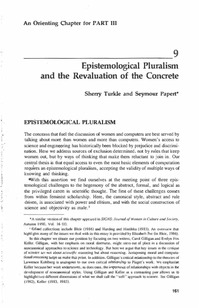
 The concems that fuel the discussion of women and computers are best served by
talking about more than women and more than computers. Women's access to
science and engineering has historically been blocked by prejudice and discrimination.
Herewe address sources of exclusion determined, not by rules that keep
women out, but by ways of thinking that make them reluctant to join in. Our
central thesis is that equal access to even the most basic elements of computation
requires an epistemological pluralism, accepting the validity of multiple ways of
knowing and thinking.
The concems that fuel the discussion of women and computers are best served by
talking about more than women and more than computers. Women's access to
science and engineering has historically been blocked by prejudice and discrimination.
Herewe address sources of exclusion determined, not by rules that keep
women out, but by ways of thinking that make them reluctant to join in. Our
central thesis is that equal access to even the most basic elements of computation
requires an epistemological pluralism, accepting the validity of multiple ways of
knowing and thinking. Dieser Text erwähnt ...
 Computer
 Intelligenz
 Kinder
 Knaben
 Künstliche Intelligenz (KI / AI)
 LOGO (Programmiersprache)
 Mädchen
 Programmieren
 Roboter
 Wissenschaft


 Dieser Text erwähnt vermutlich nicht ...
 Tagcloud
 Vorträge von Beat mit Bezug
- Informatische Bildung auf der Primarstufe: Bildungswert und Grenzen
PH FHNW, 01.03.2013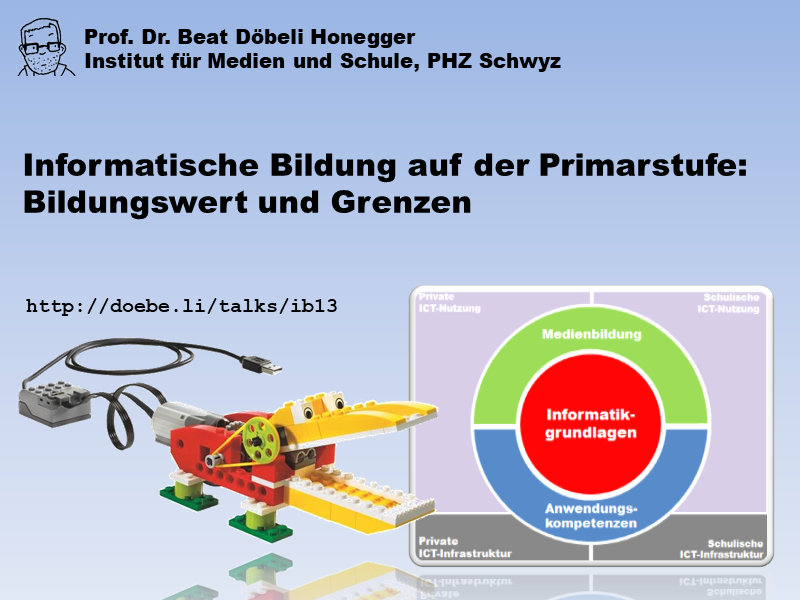
 Zitationsgraph
Zitationsgraph (Beta-Test mit vis.js)
 Zeitleiste
 28 Erwähnungen
- Comparing loops misconceptions in block-based and text-based programming languages at the K-12 level (Monika Mladenović, Ivica Boljat, Žana Žanko)
- Constructionism (Idit Harel, Seymour Papert) (1990)
- Turtles, Termites, and Traffic Jams - Explorations in Massively Parallel Microworlds (Complex Adaptive Systems) (Mitchel Resnick) (1994)

- Minds in Play - Computer Game Design As A Context for Children's Learning (Yasmin B. Kafai) (1995)
- LOG IN 5/1997 - Programmieren weltweit (1997)
- Auf dem Weg zu einer Theorie der Interaktion - Eine Entgegnung zu Peter Rechenbergs „Quo vadis Informatik?" (LOG IN, 1 997, Heft 1) (Heidi Schelhowe)
- Auf dem Weg zu einer Theorie der Interaktion - Eine Entgegnung zu Peter Rechenbergs „Quo vadis Informatik?" (LOG IN, 1 997, Heft 1) (Heidi Schelhowe)
- Constructivism in Computer Science Education (Mordechai Ben-Ari) (1998)
- Beyond Black Boxes (Mitchel Resnick, Robbie Berg, Michael Eisenberg) (2000)
- Motivation and non-majors in Computer Science - Identifying Discrete Audiences for Introductory Courses (Andrea Forte, Mark Guzdial) (2002)
- Computers for Communication, Not Calculation - Media as a Motivation and Context for Learning (Andrea Forte, Mark Guzdial) (2004)
- Computer Science Education Research (Sally Fincher, Marian Petre) (2004)
- Some Reflections on Designing Construction Kits for Kids (Mitchel Resnick, Brian Silverman) (2005)
- Creativity Support Tools - Report of Workshop on Creativity Support Tools (Ben Shneiderman, Gerhard Fischer, M. Czerwinski, Brad Myers, Mitchel Resnick) (2005)
- 3. Design Principles for Tools to Support Creative Thinking (Mitchel Resnick, Brad Myers, Kumiyo Nakakoji, Ben Shneiderman, Randy Pausch, Ted Selker, Michael Eisenberg) (2005)
- 3. Design Principles for Tools to Support Creative Thinking (Mitchel Resnick, Brad Myers, Kumiyo Nakakoji, Ben Shneiderman, Randy Pausch, Ted Selker, Michael Eisenberg) (2005)
- The Cambridge Handbook of the Learning Sciences (R. Keith Sawyer) (2006)
- Tracing the Dynabook - A Study of Technocultural Transformations (John W. Maxwell) (2006)
- Computer (ICT), Grundschule, Kindergarten und Neue Lernkultur (Hartmut Mitzlaff) (2007)
- Der Computer als Malpinsel - Technologie, Spiel und die kreative Gesellschaft (Mitchel Resnick)
- Der Computer als Malpinsel - Technologie, Spiel und die kreative Gesellschaft (Mitchel Resnick)
- Blocks to Robots - Learning with Technology in the Early Childhood Classroom (Marina Umaschi Bers) (2007)
- Does it «want» or «was it programmed to...»? - Kindergarten children’s explanations of an autonomous robot’s adaptive functioning (Sharona T. Levy, David Mioduser) (2008)
- Handbook of Technological Pedagogical Content Knowledge (TPCK) for Educators (Joel Colbert, Kim Boyd, Kevin Clark, Sharon Guan, Judith Harris, Mario Kelly, Ann Thompson) (2008)
- 1. Introducing TPCK - Confronting the
Wicked Problems of Teaching with Technology (Matthew J. Koehler, Punya Mishra) (2008)
- 1. Introducing TPCK - Confronting the
Wicked Problems of Teaching with Technology (Matthew J. Koehler, Punya Mishra) (2008)
- ITiCSE 2011 - Proceedings of the 16th Annual SIGCSE Conference on Innovation and Technology in Computer Science Education, ITiCSE 2011, Darmstadt, Germany, June 27-29, 2011 (Guido Rößling, Thomas L. Naps, Christian Spannagel) (2011)
- Habits of programming in scratch (Orni Meerbaum-Salant, Michal Armoni, Mordechai Ben-Ari) (2011)
- Habits of programming in scratch (Orni Meerbaum-Salant, Michal Armoni, Mordechai Ben-Ari) (2011)
- Be-greifbare Interaktionen - Der allgegenwärtige Computer - Touchscreens, Wearables, Tangibles und Ubiquitous Computing (Bernd Robben, Heidi Schelhowe) (2012)
- Interaktionsdesign für reflexive Erfahrung (Heidi Schelhowe)
- TechKreativ: Tangible Interfaces in Lernwelten (Nadine Dittert, Eva-Sophie Katterfeldt, Milena Reichel)
- Invent to Learn - Making, Tinkering, and Engineering in the Classroom (Sylvia Libow Martinez, Gary Stager) (2013)
- Connected Code - Why Children Need to Learn Programming (Yasmin B. Kafai, Quinn Burke) (2014)
- ICER 2014 - International Computing Education Research Conference, ICER 2014, Glasgow, United Kingdom, August 11-13, 2014 (Quintin I. Cutts, Beth Simon, Brian Dorn) (2014)
- Diversifying high school students' views about computing with electronic textiles (Kristin A. Searle, Deborah A. Fields, Debora A. Lui, Yasmin B. Kafai) (2014)
- The effect of robotics activities on students' learning and attitudes (Fatima Kaloti-Hallak) (2014)
- Diversifying high school students' views about computing with electronic textiles (Kristin A. Searle, Deborah A. Fields, Debora A. Lui, Yasmin B. Kafai) (2014)
- Making Through the Lens of Culture and Power - Toward Transformative Visions for Educational Equity (Shirin Vossoughi, Paula Hooper, Meg Escudé) (2016)
- Tomorrow's Learning: Involving Everyone. Learning with and about Technologies and Computing - 11th IFIP TC 3 World Conference on Computers in Education, WCCE 2017, Dublin, Ireland, July 3-6, 2017 (Arthur Tatnall, Mary Webb) (2017)
- 31. How Interactives Can Change Learnability of Science Concepts for Young Children – Re-positioning Them as Learners ‘Who Can and Did’ - A Decision Support Tool (Cheryl Jakab, Christine Redman)
- 31. How Interactives Can Change Learnability of Science Concepts for Young Children – Re-positioning Them as Learners ‘Who Can and Did’ - A Decision Support Tool (Cheryl Jakab, Christine Redman)
- Handbook of Technology Education (Marc J. de Vries) (2017)
- 33. Maker Movement in Education: History and Prospects (Paulo Blikstein)
- 33. Maker Movement in Education: History and Prospects (Paulo Blikstein)
 Volltext dieses Dokuments
| Epistemological pluralism and the revaluation of the concrete: Artikel als Volltext (:  , 1565 kByte; : , 1565 kByte; :  Link unterbrochen? Letzte Überprüfung: 2021-03-21 Letzte erfolgreiche Überprüfung: 2020-05-28) Link unterbrochen? Letzte Überprüfung: 2021-03-21 Letzte erfolgreiche Überprüfung: 2020-05-28) |
 Anderswo suchen
Beat und dieser Text
Beat war Co-Leiter des ICT-Kompetenzzentrums TOP während er Dieser Text ins Biblionetz aufgenommen hat. Die bisher letzte Bearbeitung erfolgte während seiner Zeit am Institut für Medien und Schule. Beat besitzt kein physisches, aber ein digitales Exemplar. Eine digitale Version ist auf dem Internet verfügbar (s.o.). Beat hat Dieser Text auch schon in Vorträgen erwähnt.
 Biblionetz-History