


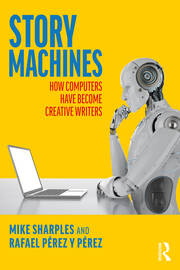
Story MachinesHow Computers Have Become Creative Writers
|
|
 Zusammenfassungen
 This book opens up story machines to see how they work and what
they tell us about creativity and story writing. We explore three routes to
designing successful story machines that work like human writers. The first,
in Chapters 3 to 6, is to build language generators that can craft a coherent text
with a beginning, middle and end, containing complications and resolutions.
The second, in Chapter 7, is to create rich storyworlds with believable
characters who have goals, motivations, desires and emotions, then let these
characters tell their experiences as stories. The third and most ambitious (in
Chapters 8 and 9), is to build a working model of a storyteller – to take what we
know about how people write and code it into a program that acts like the
mind of a creative author.
This book opens up story machines to see how they work and what
they tell us about creativity and story writing. We explore three routes to
designing successful story machines that work like human writers. The first,
in Chapters 3 to 6, is to build language generators that can craft a coherent text
with a beginning, middle and end, containing complications and resolutions.
The second, in Chapter 7, is to create rich storyworlds with believable
characters who have goals, motivations, desires and emotions, then let these
characters tell their experiences as stories. The third and most ambitious (in
Chapters 8 and 9), is to build a working model of a storyteller – to take what we
know about how people write and code it into a program that acts like the
mind of a creative author. This fascinating book explores machines as authors of fiction, past, present, and future. For centuries, writers have dreamed of mechanical storytellers. We can now build these devices. What will be the impact on society of AI programs that generate original stories to entertain and persuade? What can we learn about human creativity from probing how they work?
In Story Machines, two pioneers of creative artificial intelligence explore the design and impact of AI story generators. The book covers three themes: language generators that compose coherent text, storyworlds with believable characters, and AI models of human storytellers. Providing examples of story machines through the ages, it covers the history, recent developments, and future implications of automated story generation.
Anyone with an interest in story writing will gain a new perspective on what it means to be a creative writer, what parts of creativity can be mechanized, and what is essentially human. Story Machines is for those who have ever wondered what makes a good story, why stories are important to us, and what the future holds for storytelling.
 Kapitel
- 1. Can a computer write a story?

- 2. Human story machines
- 3. Artificial versifying
- 4. Automatic novel writers
- 5. The shape of a story
- 6. The program that swallowed the internet
- 7. Storyworlds
- 9. Modelling the mind of a writer
- 10. Build your own story generator
- 11. Capacity for empathy
 Dieses Buch erwähnt ...
 Personen KB IB clear | Sandhini Agarwal , Dario Amodei , Amanda Askell , Christopher Berner , Tom B. Brown , Mark Chen , Benjamin Chess , Rewon Child , Jack Clark , Kewal Dhariwal , Prafulla Dhariwal , Aidan N. Gomez , Scott Gray , Tom Henighan , Ariel Herbert-Voss , Christopher Hesse , Llion Jones , Lukasz Kaiser , Jared Kaplan , Gretchen Krueger , Stanley Kubrick , Mateusz Litwin , Benjamin Mann , Sam McCandlish , Elon Musk , Arvind Neelakantan , Niki Parmar , Illia Polosukhin , Alec Radford , Aditya Ramesh , Nick Ryder , Girish Sastry , Noam Shazeer , Pranav Shyam , Eric Sigler , Melanie Subbiah , Ilya Sutskever , Jakob Uszkoreit , Ashish Vaswani , Clemens Winter , Jeffrey Wu , Daniel M. Ziegler | |||||||||||||||||||||||||||
 Begriffe KB IB clear |
 Algorithmusalgorithm
, Automatautomat
, AutorInnenauthor
, Bewusstseinconsciousness
, Algorithmusalgorithm
, Automatautomat
, AutorInnenauthor
, Bewusstseinconsciousness
,  bias
, Bildungeducation (Bildung)
, bias
, Bildungeducation (Bildung)
,  bitcoin
, clickbait
, bitcoin
, clickbait
,  Computercomputer
, Computercomputer
,  Computerspielecomputer game
, Computerspielecomputer game
,  Datendata
, Datendata
,  Digitalisierung
, Empathieempathy
, Digitalisierung
, Empathieempathy
,  facebook
, facebook
,  Gehirnbrain
, Gehirnbrain
,  Generative Machine-Learning-Systeme (GMLS)computer-generated text
, Generative Machine-Learning-Systeme (GMLS)computer-generated text
,  Generative Pretrained Transformer 3 (GPT-3)
, Generative Pretrained Transformer 3 (GPT-3)
,  Geschäftsmodellbusiness model
, Geschäftsmodellbusiness model
,  Gesellschaftsociety
, Gesellschaftsociety
,  Google
, Google
,  GPT-2
, GPT-2
,  Innovationinnovation
, Innovationinnovation
,  Internetinternet
, Internetinternet
,  Kinderchildren
, Kinderchildren
,  Kreativitätcreativity
, Kreativitätcreativity
,  Künstliche Intelligenz (KI / AI)artificial intelligence
, Künstliche Intelligenz (KI / AI)artificial intelligence
,  Lernenlearning
, Lernenlearning
,  Maschinemachine
, Maschinemachine
,  Microsoft
, Microsoft
,  Neuronneuron
, Prognose
, Neuronneuron
, Prognose
,  Programmierenprogramming
, Programmierenprogramming
,  Religionreligion
, Religionreligion
,  Schachchess
, Schreibenwriting
, Schachchess
, Schreibenwriting
,  Softwaresoftware
, Softwaresoftware
,  Sprachelanguage
, storytellingstorytelling
, Sprachelanguage
, storytellingstorytelling
,  Strukturstructure
, uncanny valley
, Strukturstructure
, uncanny valley
,  Wikipedia
, Wikipedia
,  Zukunftfuture Zukunftfuture
| |||||||||||||||||||||||||||
 Bücher |
| |||||||||||||||||||||||||||
Texte |
|


 Dieses Buch erwähnt vermutlich nicht ...
Tagcloud
 Zitationsgraph
Zitationsgraph (Beta-Test mit vis.js)
 Volltext dieses Dokuments
| Artificial versifying: Artikel als Volltext (:  , 913 kByte) , 913 kByte) |
| Automatic novel writers: Artikel als Volltext (: , 142 kByte) |
| Build your own story generator: Artikel als Volltext (: , 2059 kByte) |
| Can a computer write a story?: Artikel als Volltext (: , 628 kByte) |
| Human story machines: Artikel als Volltext (: , 117 kByte) |
| Modelling the mind of a writer: Artikel als Volltext (: , 140 kByte) |
| Story Machines: Gesamtes Buch als Volltext (: , 5387 kByte) |
| Storyworlds: Artikel als Volltext (: , 343 kByte) |
| The program that swallowed the internet: Artikel als Volltext (: , 217 kByte) |
| The shape of a story: Artikel als Volltext (: , 139 kByte) |
 Anderswo suchen
 Beat und dieses Buch
Beat hat dieses Buch während seiner Zeit am Institut für Medien und Schule (IMS) ins Biblionetz aufgenommen. Beat besitzt kein physisches, aber ein digitales Exemplar. (das er aber aus Urheberrechtsgründen nicht einfach weitergeben darf). Aufgrund der vielen Verknüpfungen im Biblionetz scheint er sich intensiver damit befasst zu haben.
 Biblionetz-History