


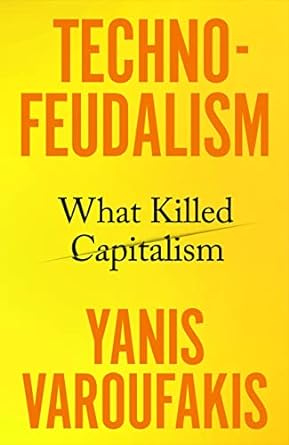
TechnofeudalismWhat Killed Capitalism
Giannis Varoufakis
,

|
|
 Zusammenfassungen
 In his 2023 book, Technofeudalism: What
Killed Capitalism, the radical economist Yanis Varoufakis, formerly
both the chief economist of the video game company
Valve and the finance minister of the sovereign nation of Greece,
argues that tech firms have transitioned away from capitalism
and into a new system he calls technofeudalism.
In his 2023 book, Technofeudalism: What
Killed Capitalism, the radical economist Yanis Varoufakis, formerly
both the chief economist of the video game company
Valve and the finance minister of the sovereign nation of Greece,
argues that tech firms have transitioned away from capitalism
and into a new system he calls technofeudalism. Perhaps we were too distracted by the pandemic, or the endless financial crises, or the rise of TikTok. But under cover of them all, a new and more exploitative system has been taking hold. Insane sums of money that were supposed to re-float our economies after the crash of 2008 went to big tech instead. With it they funded the construction of their private cloud fiefdoms and privatized the internet.
Technofeudalism says Yanis Varoufakis, is the new power that is reshaping our lives and the world, and is the greatest current threat to the liberal individual, to our efforts to avert climate catastrophe—and to democracy itself. It also lies behind the new geopolitical tensions, especially the New Cold War between the United States and China.
Drawing on stories from Greek myth and pop culture, from Homer to Mad Men , Varoufakis explains this revolutionary transformation: how it enslaves our minds, how it rewrites the rules of global power, and, ultimately, what it will take overthrow it.
 Bemerkungen zu diesem Buch
Before saying a little more on this, I must emphasise that this is not a book about what technology will do to us. It is not about AI-chatbots that will take over our jobs, autonomous robots that will threaten our lives, or Mark Zuckerberg’s ill-conceived metaverse. No, this book is about what has already been done to capitalism, and therefore to us, by the screen-based, cloud-linked devices we all use, our boring laptop and our smartphone, in conjunction with the way central banks and governments have been acting since 2008. The historic mutation of capital that I am highlighting has already happened but, caught up in our pressing dramas, from debt worries and a pandemic to wars and the climate emergency, we have barely noticed. It is high time we paid attention! Varoufakis’ Theorie besticht durch ihre Klarheit. Im Kapitalismus, erklärt er, konkurrierten Unternehmen auf agilen, fluiden und dezentralisierten Märkten, um von den durch sie hergestellten Waren zu profitieren. Je effizienter diese sind, desto höher seien die Gewinne – und desto größer seien unter sonst gleichen Bedingungen die Vorteile für die Gesellschaft. Deshalb würden die Geräte immer billiger und technisch ausgefeilter.
Die digitale Wirtschaft habe jedoch die Säulen des Systems zerstört, nämlich die Märkte und Gewinne. Der Gewinn (das Ergebnis von Wettbewerb und Produktion) sei durch die Rente (das Ergebnis von Kontrolle) ersetzt worden. Die Kapitalisten stellten Produkte her, während sich die Herren der digitalen Welt damit begnügten, die unter ihrer Kontrolle befindlichen Onlineressourcen zu monetarisieren.
 Kapitel
- The Rise of the Cloudalists and the Demise of Profit
- Escape from Technofeudalism
- 1. Hesiod’s Lament
- 2. Capitalism’s Metamorphoses
- 3. Cloud Capital
- 5. What’s in a Word?
- 6. Technofeudalism’s Global Impact: the New Cold War
 Dieses Buch erwähnt ...
 3D-Drucker
 Airbnb
 Algorithmus
 amazon
 Android
 Apple
Apple big data
 bitcoin
 blockchain
 Chat-GPT
 China
China Computer
 Daten
Daten Demokratie
 Digitalisierung
 DNS
DNS elektrische Energie
 Epidemie
 Europa
 facebook
 Freiheit
 Gesellschaft
 Globalisierung
 Inflation
 Internet
 Kapitalismus
 Klimawandel
 Künstliche Intelligenz (KI / AI)
 Palantir
 Plattformen
 Politik
 Privatsphäre
 Russland
 Schneeballsystem
 Selbstfahrende Autos
 skype
skype snapchat
 Struktur
 Technologie
 Tiktok
 Twitter
 Ukraine
 United Kingdom
 Waffe
Waffe WhatsApp
 Wikipedia
 YouTube
 Zoom
Zoom Dieses Buch erwähnt vermutlich nicht ...
 Tagcloud
 Zitationsgraph
Zitationsgraph (Beta-Test mit vis.js)
 3 Erwähnungen
- Leben wir im Technofeudalismus? (Evgeny Morozov) (2025)

- Krieg der Medien - Dark Tech und Populisten übernehmen die Macht (Martin Andree) (2025)
- Enshittification - Why Everything Suddenly Got Worse and What To Do About It (Cory Doctorow) (2025)
 Co-zitierte Bücher
Das Kapital
(Karl Marx) Volltext dieses Dokuments
| Technofeudalism: Gesamtes Buch als Volltext (: 1554 kByte) |
 Anderswo suchen
 Beat und dieses Buch
Beat hat dieses Buch während seiner Zeit am Institut für Medien und Schule (IMS) ins Biblionetz aufgenommen. Beat besitzt kein physisches, aber ein digitales Exemplar. (das er aber aus Urheberrechtsgründen nicht einfach weitergeben darf). Es gibt bisher nur wenige Objekte im Biblionetz, die dieses Werk zitieren.
 Biblionetz-History