


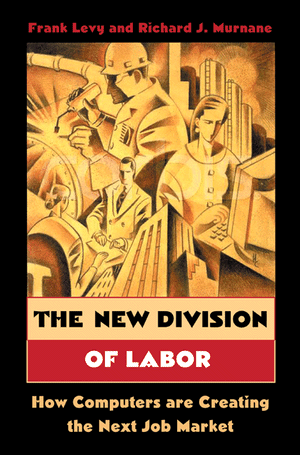
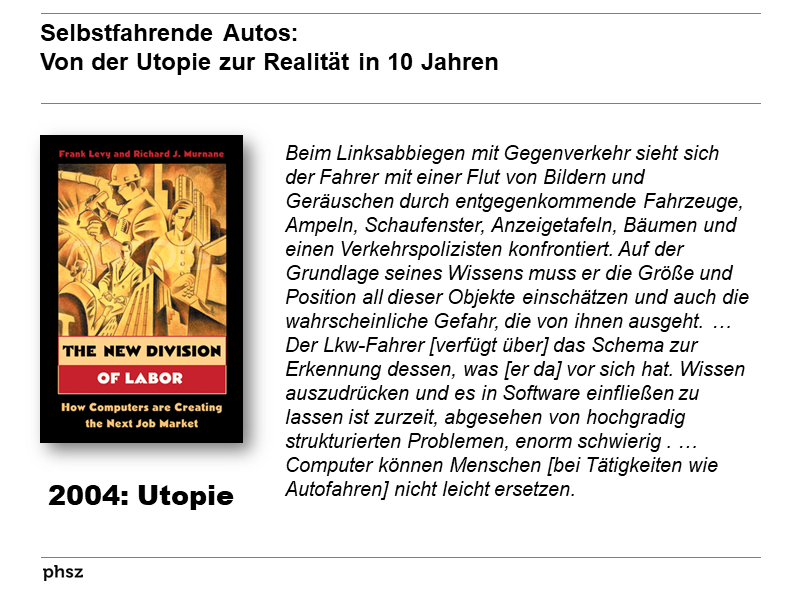
The New Division of LaborHow Computers Are Creating the Next Job Market
Frank Levy, Richard Murnane
,
|
|
 Zusammenfassungen

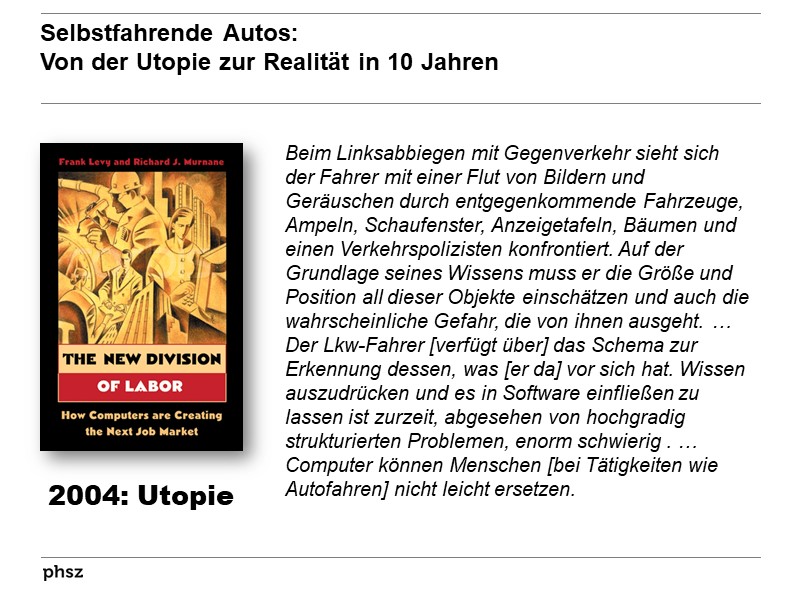
 In 2004 Frank Levy and Richard Murnane published their book The New Division of Labor. The division they focused on was between human and digital labor—in other words, between people and computers. In any sensible economic system, people should focus on the tasks and jobs where they have a comparative advantage over computers, leaving computers the work for which they are better suited. In their book Levy and Murnane offered a way to think about which tasks fell into each category.
 As the current recession ends, many workers will not be returning to the jobs they once held - those jobs are gone. In "The New Division of Labor", Frank Levy and Richard Murnane show how computers are changing the employment landscape and how the right kinds of education can ease the transition to the new job market. The book tells stories of people at work - a high-end financial advisor, a customer service representative, a pair of successful chefs, a cardiologist, an automotive mechanic, the author Victor Hugo, floor traders in a London financial exchange. The authors merge these stories with insights from cognitive science, computer science, and economics to show how computers are enhancing productivity in many jobs even as they eliminate other jobs - both directly and by sending work offshore. At greatest risk are jobs that can be expressed in programmable rules - blue collar, clerical, and similar work that requires moderate skills and used to pay middle-class wages. The loss of these jobs leaves a growing division between those who can and cannot earn a good living in the computerized economy. Left unchecked, the division threatens the nation's democratic institutions. The nation's challenge is to recognize this division and to prepare the population for the high-wage/high-skilled jobs that are rapidly growing in number - jobs involving extensive problem solving and interpersonal communication. Using detailed examples - a second grade classroom, an IBM managerial training program, Cisco Networking Academies - the authors describe how these skills can be taught and how our adjustment to the computerized workplace can begin in earnest.
 Kapitel
- 1. New Divisions of Labor


- 2. Why People Still Matter
- 3. How Computers Change Work and Pay
- 4. Expert Thinking
- 5. Complex Communication
- 6. Enabling Skills
- 7. Computers and the Teaching of Skills
- 8. Standards-Based Education Reform in the Computer Age
- 9. The Next Ten Years
 Dieses Buch erwähnt ...
 Arbeitslosigkeit
 Chatbot
 Computer
 Digitalisierung
 Eliza
Eliza Internet
 Kommunikation
 Komplementarität
 machine learning
 Mensch
 Outsourcing
 Produktivität
 Selbstfahrende Autos


 Dieses Buch erwähnt vermutlich nicht ...
Nicht erwähnte Begriffe | Informatik-Didaktik, Informatik-Unterricht (Fachinformatik), Kinder, Schule |
 Tagcloud
 3 Vorträge von Beat mit Bezug
- NMG im Zeitalter digitaler Medien
8. NMG-Fachtagung des forums NMG didaktik
PHSZ, Goldau, 28.08.2015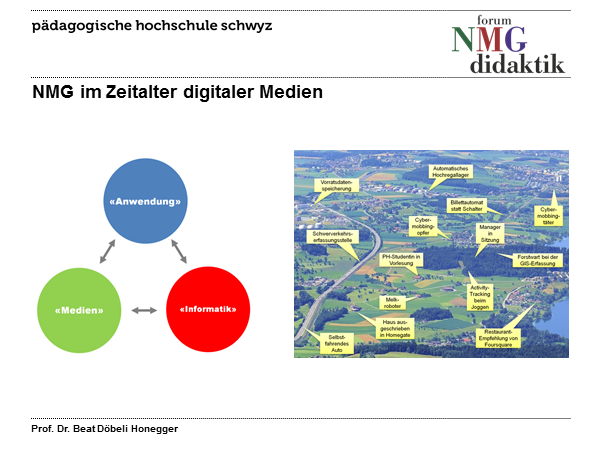
- Mehr als 0 und 1 - Schule in einer digitalisierten Welt.
Digitale Medien in der Schul- und Unterrichtsentwicklung - Herausforderung und Chance für die Bildung
Wolfsburg, 07.11.2015
- Berufsschule in einer digitalisierten Welt
Berufsbildungszentrum Goldau, 23.12.2015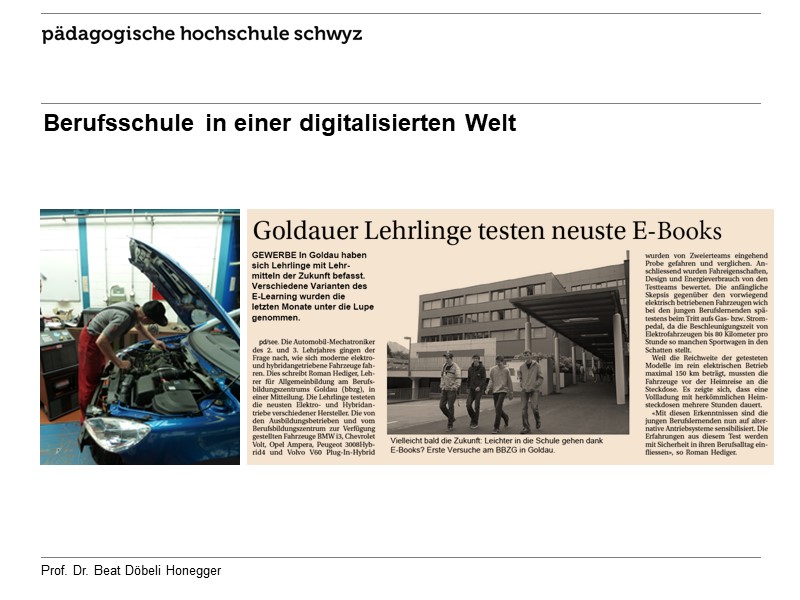
Einträge in Beats Blog
 Zitationsgraph
Zitationsgraph (Beta-Test mit vis.js)
 Zeitleiste
 23 Erwähnungen
- Images of Organization (Gareth Morgan) (1986)
- Fear of Offshoring (Alan S. Blinder) (2005)
- New Technology and Digital Worlds - Analyzing Evidence of Equity in Access, Use, and Outcomes (2010)
- Skills, Tasks and Technologies - Implications for Employment and Earnings (Daron Acemoglu, David Autor) (2010)
- Jahrbuch Medienpädagogik 9 (Renate Schulz-Zander, Birgit Eickelmann, Heinz Moser, Horst Niesyto, Petra Grell) (2011)
- Are teachers ready to teach in the knowledge society? - Considerations based on empirical findings (Joke Voogt)
- Are teachers ready to teach in the knowledge society? - Considerations based on empirical findings (Joke Voogt)
- Race Against The Machine - How the Digital Revolution is Accelerating Innovation, Driving Productivity, and Irreversibly Transforming Employment and the Economy (Erik Brynjolfsson, Andrew McAfee) (2011)
- 1. Technology’s Influence on Employment and the Economy
- Informatics in Schools - Contributing to 21st Century Education (Ivan Kalas, Roland Mittermeir) (2011)
- Education for Life and Work - Developing Transferable Knowledge and Skills in the 21st Century (James W. Pellegrino, Margaret L. Hilton) (2012)
- The Future of Employment - How Susceptible are Jobs to Computerisation? (Carl Benedikt Frey, Michael A. Osborne) (2013)
- The Second Machine Age - Work, Progress, and Prosperity in a Time of Brilliant Technologies (Erik Brynjolfsson, Andrew McAfee) (2014)

- The Glass Cage - Automation and Us (Nicholas G. Carr) (2014)
- Homo Deus - Eine Geschichte von Morgen (Yuval Noah Harari) (2015)
- Why Are There Still So Many Jobs? - The History and Future of Workplace Automation (David Autor) (2015)
- Our Robots, Ourselves - Robotics and the Myths of Autonomy (David A. Mindell) (2015)
- Mehr als 0 und 1 - Schule in einer digitalisierten Welt (Beat Döbeli Honegger) (2016)
- Lehrmittel in einer digitalen Welt (Beat Döbeli Honegger, Michael Hielscher, Werner Hartmann) (2018)
- The Technology Trap - Capital, Labor, and Power in the Age of Automation (Carl Benedikt Frey) (2019)
- Public Management - Erfolgreiche Steuerung öffentlicher Organisationen (6. Auflage) (Adrian Ritz, Norbert Thom) (2019)
- Failure to Disrupt - Why Technology Alone Can’t Transform Education (Justin Reich) (2020)
- 7. The Trap of Routine Assessment
- 4K und digitale Kompetenzen - Chancen und Herausforderungen (Manfred Pfiffner, Saskia Sterel, Dominic Hassler) (2021)
- Schulen für die Zukunft gestalten - Gutachten zur Entwicklung von räumlichen Lehr-Lernsettings für die Stadtmedienzentren Stuttgart und Karlsruhe (Frank Thissen, Richard Stang) (2021)
- Digitale Lernplattformen in der Volksschule - Überlegungen zu Potenzialen, Herausforderungen und Einflüssen auf das Lehren und Lernen (Beat Döbeli Honegger, Michael Hielscher, Lennart Schalk, Michael Seemann) (2026)
 Co-zitierte Bücher
Mind Children
(Hans Moravec)Das Kapital
(Karl Marx)
Problem-based learning
An approach to medical education
(H. Barrows, R. Tamblyn) (1980)


Work, Progress, and Prosperity in a Time of Brilliant Technologies
(Erik Brynjolfsson, Andrew McAfee) (2014) 

How the Digital Revolution is Accelerating Innovation, Driving Productivity, and Irreversibly Transforming Employment and the Economy
(Erik Brynjolfsson, Andrew McAfee) (2011) 


The Race between Education and Technology
(Claudia Goldin) (2008)


Skills, Tasks and Technologies
Implications for Employment and Earnings
(Daron Acemoglu, David Autor) (2010) 
Employment, Skills and Workforce Strategy for the Fourth Industrial Revolution
(World Economic Forum (WEF)) (2016)  Volltext dieses Dokuments
| New Divisions of Labor: Artikel als Volltext (:  , 49 kByte; : , 49 kByte; :  2020-11-28) 2020-11-28) |
| Computers and the Teaching of Skills: Artikel als Volltext (: , 129 kByte; : 2020-11-28) |
| The Next Ten Years: Artikel als Volltext (: , 86 kByte; : 2020-11-28) |
| Why People Still Matter: Artikel als Volltext (: , 233 kByte; : 2020-11-28) |
| How Computers Change Work and Pay: Artikel als Volltext (: , 128 kByte; : 2020-11-28) |
| Expert Thinking: Artikel als Volltext (: , 105 kByte; : 2020-11-28) |
| Complex Communication: Artikel als Volltext (: , 120 kByte; : 2020-11-28) |
| Enabling Skills: Artikel als Volltext (: , 89 kByte; : 2020-11-28) |
 Bibliographisches
| Titel | Format | Bez. | Aufl. | Jahr | ISBN | ||||||
| The New Division of Labor | E | - | - | 0 | 0691124027 |  |
 |
 |
 |
Beat und dieses Buch
Beat hat dieses Buch während seiner Zeit am Institut für Medien und Schule (IMS) ins Biblionetz aufgenommen. Beat besitzt weder ein physisches noch ein digitales Exemplar. Beat hat dieses Buch auch schon in Vorträgen sowie in Blogpostings erwähnt.
 Biblionetz-History