


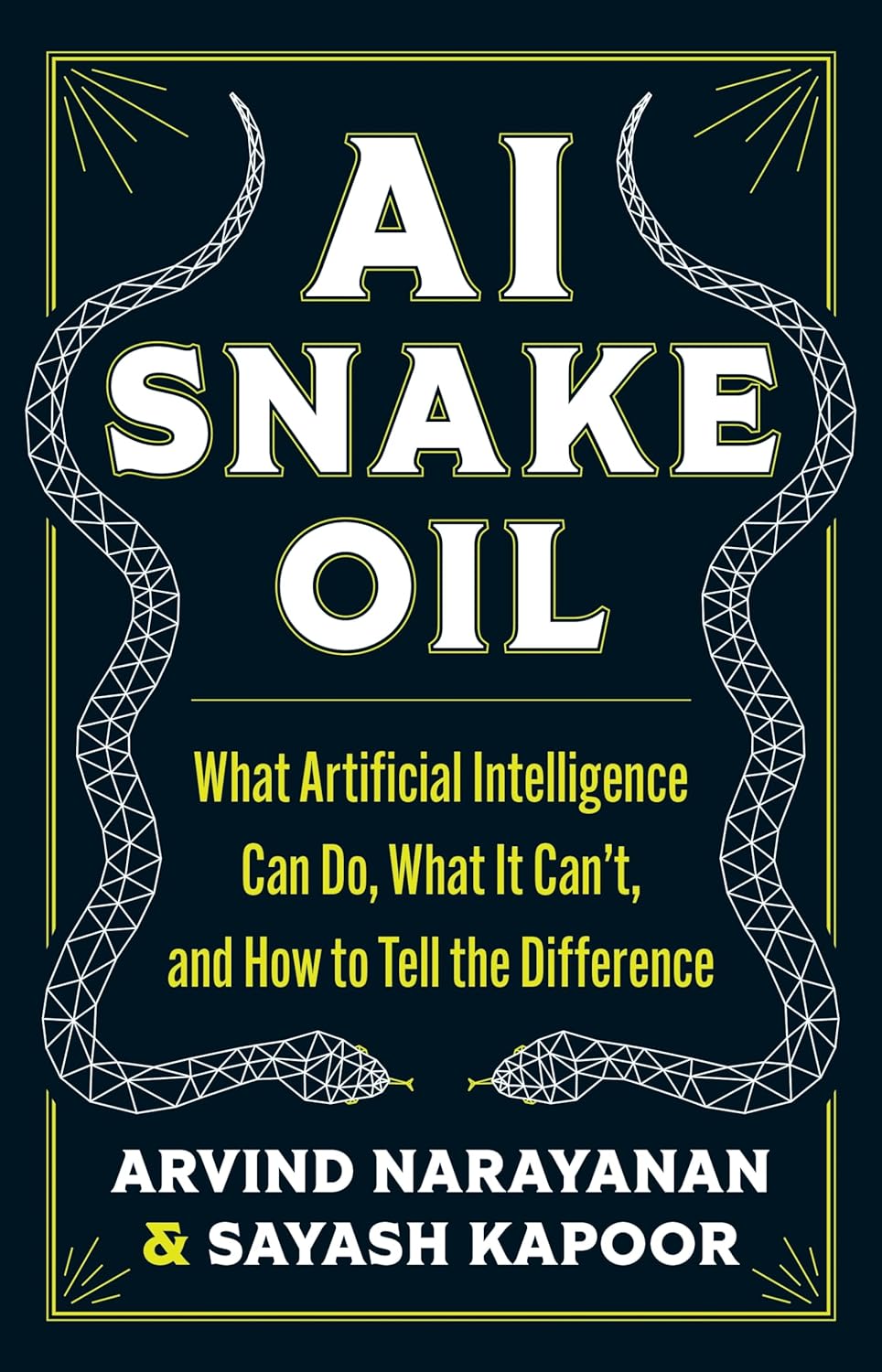
AI Snake OilWhat Artificial Intelligence Can Do, What It Can’t, and How to Tell the Difference
|
|
 Zusammenfassungen
 Confused about AI and worried about what it means for your future and the future of the world? You’re not alone. AI is everywhere—and few things are surrounded by so much hype, misinformation, and misunderstanding. In AI Snake Oil, computer scientists Arvind Narayanan and Sayash Kapoor cut through the confusion to give you an essential understanding of how AI works, why it often doesn’t, where it might be useful or harmful, and when you should suspect that companies are using AI hype to sell AI snake oil—products that don’t work, and probably never will.
While acknowledging the potential of some AI, such as ChatGPT, AI Snake Oil uncovers rampant misleading claims about the capabilities of AI and describes the serious harms AI is already causing in how it’s being built, marketed, and used in areas such as education, medicine, hiring, banking, insurance, and criminal justice. The book explains the crucial differences between types of AI, why organizations are falling for AI snake oil, why AI can’t fix social media, why AI isn’t an existential risk, and why we should be far more worried about what people will do with AI than about anything AI will do on its own. The book also warns of the dangers of a world where AI continues to be controlled by largely unaccountable big tech companies.
By revealing AI’s limits and real risks, AI Snake Oil will help you make better decisions about whether and how to use AI at work and home.
 Bemerkungen zu diesem Buch
This book is about the types of AI that are problematic in some way, because you wouldn’t want to read three hundred pages on the virtues of spell-check. But it’s important to recognize that not all AI is problematic—far from it. Kapitel
 Dieses Buch erwähnt ...
 Algorithmus
 amazon
 Arbeitslosigkeit
 bias
bias bitcoin
 Bullshit
 Chat-GPT
 China
China cloud computing
 Datenbank
 deep learning
 deepfake
 Demokratie
 E-Assessment
 E-Learning
 Eliza
Eliza Empfehlungs-Algorithmus
 facebook
 Familie
 Fehler
 Generation Alpha
 Generative Machine-Learning-Systeme (GMLS)
 Generative Pretrained Transformer 3 (GPT-3)
 Generative Pretrained Transformer 4 (GPT-4)
 Gesellschaft
 Gesichtserkennung
 Google
 Hype Cycle
 influencer
 Instagram
 Internet
 iPad
iPad iPhone
 Journalismus
 Kinder
 Künstliche Intelligenz (KI / AI)
 machine learning
 Mastodon
 Microsoft
 Perceptron
 PowerPoint
 Predictive Analytics
 Privatsphäre
 Psychologie
 QR Code
 Ranking
 Roboter
 Russland
 Schach
 social media / Soziale Medien
 Sprache
 Tiktok
 Twitter
 Uber
Uber Waffe
Waffe WhatsApp
 Wissenschaft
 WWW (World Wide Web)
 Zukunft

 Dieses Buch erwähnt vermutlich nicht ...
Nicht erwähnte Begriffe | 2D-Barcodes, Apple, argumentum ad hominem tu quoque, blockchain, bluesky, Chatbot, Daten, Digitalisierung, Eltern, GMLS & Bildung, GMLS & Schule, LehrerIn, Lernen, Negative Rückkoppelung, Positive Rückkoppelung / Teufelskreis, Schule, Siri, snapchat, Sprachassistenten, straw man, Tablet, Ukraine, Unterricht |
 Tagcloud
 Zitationsgraph
Zitationsgraph (Beta-Test mit vis.js)
 5 Erwähnungen
- KI und Demokratie - Zukunftsbeiträge aus Wissenschaft und Praxis (Ramona Casasola-Greiner, Korbinian Rüger)


- Eine sozial-ökologische Zukunft mit KI? - Eine progressive Perspektive wider den AI-Futurismus (Jonah Schwope, Lena Schroeder)
- Eine sozial-ökologische Zukunft mit KI? - Eine progressive Perspektive wider den AI-Futurismus (Jonah Schwope, Lena Schroeder)
- Education for the Age of AI (Charles Fadel, Alexis Black, Robbie Taylor, Janet Slesinski, Katie Dunn) (2024)
- Open Letter: Stop the Uncritical Adoption of AI Technologies in Academia (2025)
- Let Them Eat Large Language Models - Artificial Intelligence and Austerity in the Neoliberal University (Martha Kenney, Martha Lincoln) (2025)
- GenAI in Higher Education - Redefning Teaching and Learning (Sam Illingworth, Rachel Forsyth) (2025)
 Co-zitierte Bücher


 Volltext dieses Dokuments
| AI Snake Oil: Gesamtes Buch als Volltext (: 14491 kByte) |
 Anderswo suchen
 Beat und dieses Buch
Beat hat dieses Buch während seiner Zeit am Institut für Medien und Schule (IMS) ins Biblionetz aufgenommen. Beat besitzt kein physisches, aber ein digitales Exemplar. (das er aber aus Urheberrechtsgründen nicht einfach weitergeben darf). Aufgrund der vielen Verknüpfungen im Biblionetz scheint er sich intensiver damit befasst zu haben. Es gibt bisher nur wenige Objekte im Biblionetz, die dieses Werk zitieren.
 Biblionetz-History